Client / Sector
PlaybookDZ, applied AI education
Market
Algeria, working professionals and companies
Engagement
Brand identity, enrollment platform, AI ad-creative system
Status / Year
Live cohorts, 2026
The situation
By 2026, 'AI training' in Algeria mostly meant the same evening: a projector, a list of prompts, a demonstration of ChatGPT writing a poem. The audience left impressed and changed nothing about their Monday. The gap was not curiosity, because Algerian professionals pick up new tools quickly and trade tips long before those tools reach any classroom. The gap was applicability. A pharmacist, a school teacher and an agency media buyer had all sat through the same generic session, and none of them had been shown the workflow they actually run.
PlaybookDZ was founded on the opposite premise: that AI education is only useful when it is indexed to a job. The school teaches the tools a profession genuinely touches. A marketer learns Midjourney because campaigns need visuals, a developer learns Cursor because that is where their week happens, an operations lead learns n8n because their problem is repetition rather than writing. The founding brief to us was to make that promise legible in the first five seconds on a landing page, and to make it operationally real behind the scenes.
That created a double mandate. PlaybookDZ needed a brand and a platform: nine programme narratives, cohort enrollment with genuinely limited seats, a pricing surface, a companies track for team training. But it also needed a marketing engine, because a school with nine audiences cannot buy attention with one advert. We were engaged to build both, the product and the creative system that feeds it.
What made this hard
Nine value propositions, one homepage
Most education sites sell one promise. PlaybookDZ sells nine, and each one only lands if the visitor recognises their own job in it. Generic copy would flatten all nine into 'learn AI', the exact positioning the school exists to reject, so the information architecture had to route a stranger to their profession before it tried to sell them anything.
The tools are the proof
In this market, credibility comes from naming the software, not from adjectives. A visitor believes a programme when they see ChatGPT, Claude, Midjourney, n8n and Cursor on the page, and stops believing when they see 'cutting-edge AI technologies'. That meant the tool stack had to be a first-class content object rendered across the site, not a decorative logo strip added at the end.
Scarcity that has to be true
Live cohorts have a real capacity ceiling, because an instructor can only run a room of a certain size and the whole pedagogical claim collapses if seats are unlimited. 'Seats are limited' is therefore an operational fact rather than a conversion tactic, and the platform had to model cohort capacity as data the school controls rather than as static copy someone forgets to update.
Certification without overclaiming
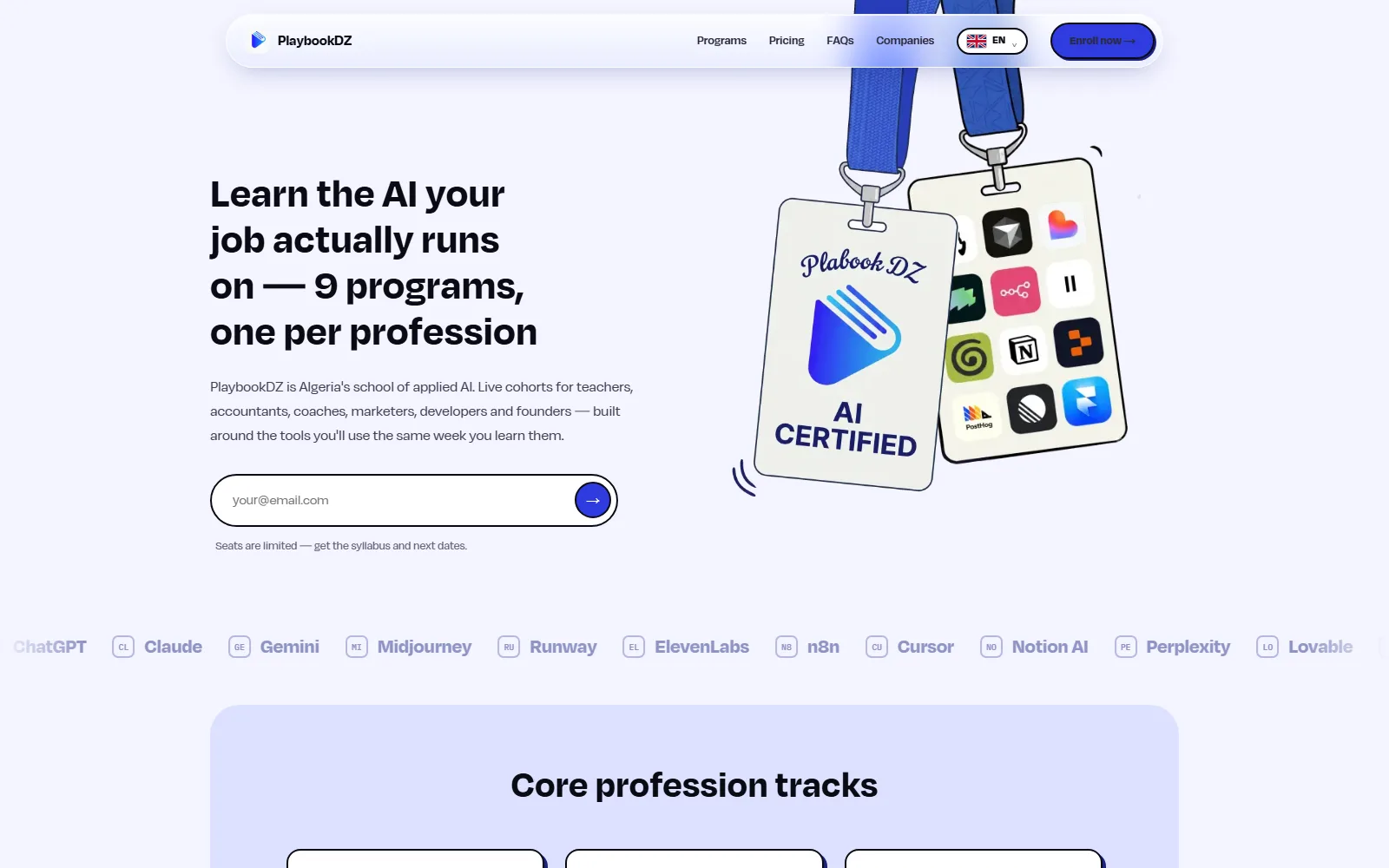
The brand's most distinctive asset is a certified badge: a lanyard, a card, the visual language of professional accreditation. That is powerful and dangerous in equal measure. We had to build an identity that feels credential-grade while the copy stays precise about what the certificate is, namely proof of completing a PlaybookDZ programme and not a state or institutional accreditation.
Paid acquisition eats creative faster than a school can make it
Meta ad sets fatigue quickly, and PlaybookDZ needs to reach at least nine distinct professional audiences at once. Producing bespoke shoots per audience is impossible at a school's budget, and running one generic creative across all nine defeats the positioning. The creative problem was structurally the same as the product problem: one idea, nine faces.
How we approached it
We treated PlaybookDZ as a single system with two output surfaces. The brand and the platform define what a programme is; the creative engine takes that same definition and recasts it for paid distribution. Once a programme exists as structured data, with a profession, a promise, a tool stack, a cohort and a seat count, both the website and the ad account can be generated from it rather than maintained independently.
The design direction went deliberately playful against a serious market: deep indigo and electric blue on a soft lavender ground, an illustrated lanyard badge as the hero object, warm rounded type. It reads as a school that belongs to the profession-tech world rather than to the formal-training world. The tone the client wanted was a first-person promise, and the headline settled it in one line, teaching the AI your job actually runs on.
Positioning and programme architecture
We mapped the nine professions and, for each, the specific tools and deliverables that make a working week measurably different: teachers, accountants, lawyers, marketers, developers, coaches, HR, researchers and founders. Each track got a promise sentence, a tool list and an outcome, all written to the same shape so they could be compared side by side without any track looking like the runt.
Brand identity and the certified badge
We built the identity around a single memorable object: a conference-style lanyard with an AI CERTIFIED card. It gave the school a mark that photographs, animates and works as an avatar, and it set the palette and illustration language for everything downstream. The rest of the system, meaning the type scale, card shapes, tool chips and button treatments, was derived from that one asset.
Platform build
We shipped the site as a typed React application: a programme content model rendered into nine track pages, a pricing surface, an FAQ layer, a companies route for team training, and a header language switcher for the bilingual audience. Enrollment starts where the hero starts, with a syllabus and next-dates request against a seat-capped cohort.
The AI creative engine
We wrote one campaign concept and built a pipeline that recasts it per audience, covering accountants, medical researchers, coaches, HR and legal professionals, keeping the composition, structure and brand furniture constant while the subject, setting and copy change. Every generated asset passes a human review gate before it reaches the ad account.
Launch and cohort operations
We took the school live with cohorts open, connected the creative pack to the ad account with a naming convention that keeps audience, concept and variant readable in reporting, and handed over the loop: publish a cohort, generate its audience-specific creative, run it, refill seats.
What we shipped
Brand system
- Certified-badge identity built on an illustrated lanyard and AI CERTIFIED card
- Indigo and electric blue palette on a light lavender ground
- Rounded editorial type scale for headlines and promise lines
- Tool-chip component that treats named software as a repeatable brand element
- Illustration language reusable across site, social and ad assets
Programme platform
- Nine profession tracks driven from one typed programme model
- Per-track tool stacks covering ChatGPT, Claude, Midjourney, n8n, Cursor, Notion AI and others
- Cohort enrollment with seat-capped availability
- Syllabus and next-dates capture as the primary entry point
- Pricing surface and structured FAQ layer
- Companies route for team and organisation training
Marketing engine
- One campaign concept, recast per professional audience
- AI-generated creative pack for accountants, medical researchers, coaches, HR and legal professionals
- Brand-locked composition so variants stay recognisably PlaybookDZ
- Human review gate before any generated asset goes live
- Ad-account naming convention mapping audience, concept and variant
- Produced through the KinxLab content studio, documented at /content-creation
Site and growth surface
- Bilingual marketing with a header language switcher
- Static-first rendering for a fast first paint
- Programme, pricing and FAQ pages structured for search
- Email capture wired to the cohort pipeline
- Social and ad exports generated from the same design tokens
Engineering decisions
The choices that shaped the build, and what each one traded away.
One programme schema, nine rendered tracks
Every profession track is an entry in a single typed TypeScript model covering promise, audience, tool stack, outcomes and cohort state, and the track pages, comparison surfaces and navigation all render from it. Adding a tenth profession is a data edit rather than a new page build, and no track can silently drift out of the shared shape. The trade-off is real: a track that wants a bespoke section has to either bend to the schema or push us to extend it for all nine, which we chose deliberately over letting nine pages diverge.
Seat scarcity modelled as state, not copy
Cohort capacity lives in the content model rather than being typed into a headline, so the scarcity message and the enrollment surface cannot contradict each other. When a cohort fills, the page says so because the data says so. The cost is operational discipline: someone at the school has to keep cohort records current, and a stale record is now visible to the public instead of hiding in a spreadsheet.
Copy as typed dictionaries rather than a CMS
For a bilingual marketing site of this size, we kept all strings in typed language dictionaries with shared keys instead of standing up a headless CMS. Missing translations become compile-time errors rather than empty paragraphs in production, and the whole site stays statically renderable with no editorial backend to secure or pay for. The trade-off is that marketing copy changes require a developer and a deploy, which is acceptable while the school is nine programmes and the first thing we would revisit if the catalogue triples.
A concept-locked generative creative pipeline
The ad system holds the concept, framing and brand furniture constant and varies only the audience layer: the profession, the environment, the props, the copy. Locking the invariants is what makes nine variants read as one campaign instead of nine unrelated adverts, and it also makes generation cheap enough to refresh when creatives fatigue. The trade-off we accepted is a mandatory human review step, because generative output still produces artefacts that would embarrass a school selling professional credibility, so nothing reaches the ad account unreviewed.
Static-first delivery for paid-click traffic
The site is built to be served as static output with no per-request server work on the critical path, because most visitors arrive on a cold click from an advert and judge the school on the first screen. The only dynamic dependency in the funnel is the capture endpoint. The trade-off is that anything genuinely personalised has to be handled client-side or deferred, which is why the platform's first version keeps the account surface intentionally thin.
The outcome
PlaybookDZ is in market as a school rather than a landing page. Nine profession programmes are published with their real tool stacks, cohorts run live with capacity that the platform reflects, and a visitor arriving from an advert lands on a page written for their job rather than on a generic AI course pitch. The certified-badge identity does what it was designed to do, giving a young school a recognisable mark in a category where most competitors have no visual identity at all.
The more interesting change is operational. Because a programme is a data object, the school can open a cohort, publish its page and generate its audience-specific creative from the same source of truth. Announcing a new accountants cohort and getting adverts for it into the account are now the same editing pass rather than two separate production efforts, which matters for a school competing for attention against much larger advertising budgets.
For us, the engagement proved out a working pattern: brand, platform and creative built as one system rather than three procurement lines. The same design tokens that render a programme card render an advert, and the same schema that describes a cohort briefs its campaign.
9
Profession programmes
One track per profession, covering teachers, accountants, lawyers, marketers, developers, coaches, HR, researchers and founders, each rendered from a single shared content model.
12+
AI tools in the curriculum
Named software taught across the tracks, including ChatGPT, Claude, Midjourney, n8n, Cursor and Notion AI, with the per-track stack published on each programme page.
Live
Cohort delivery model
Seat-capped live cohorts rather than an evergreen recorded catalogue, with capacity modelled as platform state so availability and copy cannot diverge.
Bilingual
Marketing surface
The site ships with a header language switcher and typed string dictionaries, so both language versions stay structurally identical rather than drifting apart.
Honestly
The first thing we would flag is the deliberate thinness of the platform's account layer. PlaybookDZ v1 optimises for getting the right professional into the right cohort. It does not try to be a learning management system, host video, or track progress. That was the correct call for a school whose value is in a live room, but it does mean that the day PlaybookDZ wants an alumni portal, a resource library or asynchronous cohorts, that is a genuine second build rather than a feature toggle.
The second honest note is about the generative creative system. It is fast and it holds brand coherence well, but it is not autonomous and we do not present it as such. Every asset passes a human eye before it runs, and that gate is the reason the output is usable. Anyone selling a fully hands-off AI ad factory is selling a review step they have quietly removed, and in a category built on professional credibility that is the one step you cannot afford to skip.
Frequently asked
How do you build an online course platform for the Algerian market?
Start with the content model, not the page designs. We define a programme as structured data, covering audience, promise, tool stack, cohort and capacity, then render every surface from it. For this market specifically we keep the enrollment entry point light rather than forcing an account, publish the tool stack openly because that is what earns trust, and design the language layer in from the beginning instead of bolting a second language on later.
Can AI generate ad creative for different audiences from one concept?
Yes, and that is exactly the right use of it. We lock the concept, composition and brand elements, then vary only the audience layer of profession, setting, props and copy, so a single campaign idea can address accountants, coaches, HR or legal professionals and still read as one brand. The essential ingredient is a human review gate before anything runs, because generative output is fast rather than finished.
What is the difference between a live cohort and a recorded online course?
A live cohort has a real capacity ceiling, a fixed calendar and an instructor in the room, which is why PlaybookDZ can promise profession-specific work rather than generic lessons. Practically, it changes the software too: the platform must model seats and dates as live state, because scarcity that is only written in the copy stops being true the moment someone forgets to edit it.
Does KinxLab do brand identity as well as the website build?
On this project we did brand identity, the platform build and the ad creative system as one engagement. That is usually the better arrangement, because the design tokens that render a programme card also render an advert, and the schema that describes a cohort briefs its campaign, so the brand stays coherent across surfaces instead of being reinterpreted by whoever handles the next channel.