Client / Sector
Ahjazli Qaati - two-sided marketplace for wedding halls, event salons and conference rooms
Market
Algeria, all 58 wilayas, Arabic-first with French venue vocabulary
Engagement
Brand, marketplace UX, owner listing dashboard, location and SEO architecture
Status / Year
Live, 2025
The situation
Finding a wedding hall in Algeria is still an offline problem solved with a phone. You ask family, you follow a Facebook page with a phone number and a dozen compressed photos, or you drive around a neighbourhood reading signs. Weddings here are enormous, intensely seasonal and booked far in advance, and the host has no way to compare capacity, price band and availability across a wilaya except by calling venues one at a time.
The owner's side is just as constrained. A hall in a mid-size wilaya markets itself through word of mouth and a roadside sign, which is a distribution radius of a few kilometres for a venue that only earns on the nights it is booked. There is no channel that reaches the host who lives three wilayas away, no way to show the space properly, and no reliable signal about how much demand exists.
There is also a hard fact about where the demand actually starts: it starts in a search box. People type qaat afrah plus a city name, or salle des fetes plus a city name, in a mix of Arabic and French that reflects how Algerians actually talk. A marketplace that only exists as an application is invisible to that query. This one had to be built so that the search result itself is the front door - which turns the location page architecture from a marketing afterthought into the core product decision.
What made this hard
A marketplace has to be worth an owner's money on day one
Cold start cuts both ways: owners will not pay to be listed in an empty directory, and hosts will not visit one. The listing had to deliver value independent of marketplace traffic - a real, indexable web page that answers a search a host was already making - so an owner gets something concrete before the network effect exists.
The deposit is settled in person, not through a checkout
A venue is booked after a site visit, a negotiated date and a cash deposit handed over face to face. Forcing that agreement through an on-platform payment step would have been theatre: owners would move the conversation to WhatsApp anyway, and the platform would be measuring a fiction. The handoff from listing to owner had to be designed as the product, not treated as a leak.
58 wilayas and eight categories is 464 pages nobody has content for
The naive version of location SEO generates every combination and ships hundreds of near-empty pages. Search engines correctly classify that as doorway spam, and the whole domain pays for it. The architecture had to decide which location pages deserve to exist, and what happens to the ones that do not.
Every place name has at least three spellings
A hall in Algiers is searched for in Arabic script with variable orthography, in French, and in Latin transliteration, often within the same sentence. Even the product vocabulary is mixed: hosts say salle in the middle of an Arabic query. Search and routing had to tolerate all of it and still resolve to one place.
The listing is the photographs
A venue is sold visually: the hall dressed, the lighting, the capacity you can see. That means galleries of large images and video on mobile connections, and it means the median listing looking credible, which is a moderation problem before it is an engineering one.
How we approached it
We designed Ahjazli Qaati around a single organising idea: the platform's job is to be found, and then to get out of the way. Everything on the host side optimises for going from a search query to a shortlist of real venues with real photographs, and then to a direct conversation with the owner. Everything on the owner side optimises for getting a credible listing live without a salesperson.
That framing decided the business model too. Revenue comes from time-boxed listing plans rather than a commission on bookings the platform cannot observe, which keeps the incentives pointed at supply quality and page quality instead of at trapping a conversation inside a chat widget.
Market model and information architecture
We mapped how hosts actually shortlist a venue, which is wilaya first, then category, then capacity and price band, and built the taxonomy around that order rather than around how an owner would describe their own hall. The category system for halls, salons, conference rooms and outdoor spaces came out of this pass.
Brand and discovery experience
An Arabic-first, right-to-left interface with a premium editorial feel appropriate to a wedding purchase, built around large venue photography and comparison-friendly cards. Search, filters and the venue page were designed as one continuous shortlisting flow.
Owner side and listing lifecycle
Self-serve registration, listing creation with unlimited images and video, venue details and contact links, then a review step before publication. Owners get a dashboard showing listing views and incoming requests, and manage their own plan and renewal.
Location and SEO architecture
We built the per-wilaya and per-category page set as a generated, inventory-aware system: which pages exist, what they canonicalise to, how they link to each other, and how the sitemap is produced from the database rather than maintained by hand.
Supply seeding and launch
We launched with the directory populated rather than empty, and with the entry-tier plan priced to make a first listing an easy decision for an owner who has never paid for digital marketing before.
What we shipped
Discovery for hosts
- Search by wilaya, city and neighbourhood
- Filters for category, guest capacity and price range
- Venue pages with full photo galleries and video
- Comparison-oriented result cards showing capacity and location at a glance
- Direct contact with the owner by WhatsApp, phone or social profile
- How-it-works and FAQ content for first-time users of the platform
Owner console
- Self-serve account creation and listing submission
- Unlimited image upload plus video for the venue gallery
- Structured venue details: capacity, category, location, amenities, price band
- Contact details and social links on the listing
- Review and approval state before a listing goes live
- Performance view of listing views and incoming requests
Location and SEO architecture
- Per-wilaya landing pages across the full national map
- Category and wilaya combinations generated only where real inventory exists
- Canonical rules routing thin combinations to their parent page
- Sitemap generated from live inventory rather than hand-maintained
- Arabic-first metadata and structured data for venue listings
- Internal linking between neighbouring wilayas and sibling categories
Platform
- Right-to-left layout as the default direction, not a variant
- Cloud media pipeline with responsive derivatives for heavy galleries
- Moderation queue for new and edited listings
- Time-boxed listing plans at an entry and a premium tier
- Listing expiry handled as a state rather than a deletion
Engineering decisions
The choices that shaped the build, and what each one traded away.
Location pages are generated from inventory, not from the cross product
Fifty-eight wilayas multiplied by eight categories gives 464 possible landing pages, and on day one most of those combinations have no venues at all. We gate page generation on real inventory: a combination becomes its own indexable page when it has enough listings to be genuinely useful, and until then it resolves to the parent wilaya or category page with a filter applied and a canonical pointing there. The trade-off is a smaller indexable footprint and a long tail that fills in slowly - but the pages that exist are all substantive, and the domain never has to recover from being classified as a doorway network.
The handoff to the owner is the conversion, so we instrumented it instead of fighting it
Hosts book directly with the venue, and we deliberately did not put a payment step in the middle of that. Deals here close with a visit and a cash deposit, so an on-platform checkout would have been a fiction that owners route around within a week. Instead the venue page hands the host straight to the owner by WhatsApp, phone or social profile, and the platform records views and contact requests and shows them back to the owner in their dashboard. The cost is significant and we accepted it knowingly: the platform cannot verify that a booking happened, so what it sells owners is measurable demand, not attributed revenue.
Place names are normalised, because nobody spells them the same way
Algerian place names arrive in Arabic script with unstable orthography, in French, and in Latin transliteration, and the venue vocabulary itself is bilingual: the browse path pairs an Arabic locale with a French word for hall, because that is how the market speaks. Search normalises across those forms so any spelling of a wilaya or commune resolves to the same location entity. The trade-off is fuzzier matching on rare exact venue names, which we accept: a host searching for a hall usually does not know its registered spelling.
Moderation is a gate, not a filter
Owners publish themselves, but a listing waits for review before it goes live. An automated pipeline would scale better and we chose not to use one, because a venue marketplace is only worth visiting if the photographs match the hall, and the first few hundred listings set the perceived quality of the whole directory. The cost is a throughput ceiling and a slower time-to-live for a new owner, a real friction we monitor and the first thing that would need automating at scale.
Media is the product, so the media pipeline is not an afterthought
Listings carry unlimited images plus video, and they are viewed mostly on mobile connections, so originals are pushed through cloud storage and served as responsive derivatives rather than shipped as uploaded. The trade-off is a processing step and a storage cost carried on every listing, whether or not that listing ever converts. We pay it because a gallery-heavy venue page has to stay usable on a phone, which is the only device most hosts will ever shortlist on.
The outcome
Ahjazli Qaati gives a hall owner in a wilaya with no digital presence something they could not previously buy at any price: a page that answers a search a host is already making, with the photographs, capacity and contact details on it. For an owner whose marketing was a roadside sign, that is a distribution change rather than a marketing upgrade.
On the host side, the shortlisting that used to happen on the phone now happens before any call is made. Hosts filter by wilaya, category, capacity and price band, look at real galleries, and then contact only the venues worth visiting. Owners get the other half of that: a caller who has already seen the room, its capacity and its price band, rather than one who is starting from a phone number under a Facebook photo.
The location architecture is what compounds. Every wilaya that gains real inventory unlocks a substantive landing page, that page earns queries that no single owner could compete for alone, and the traffic it brings makes listing more valuable to the next owner in that wilaya. That is the flywheel this marketplace runs on, and it is a search architecture decision far more than a marketing one.
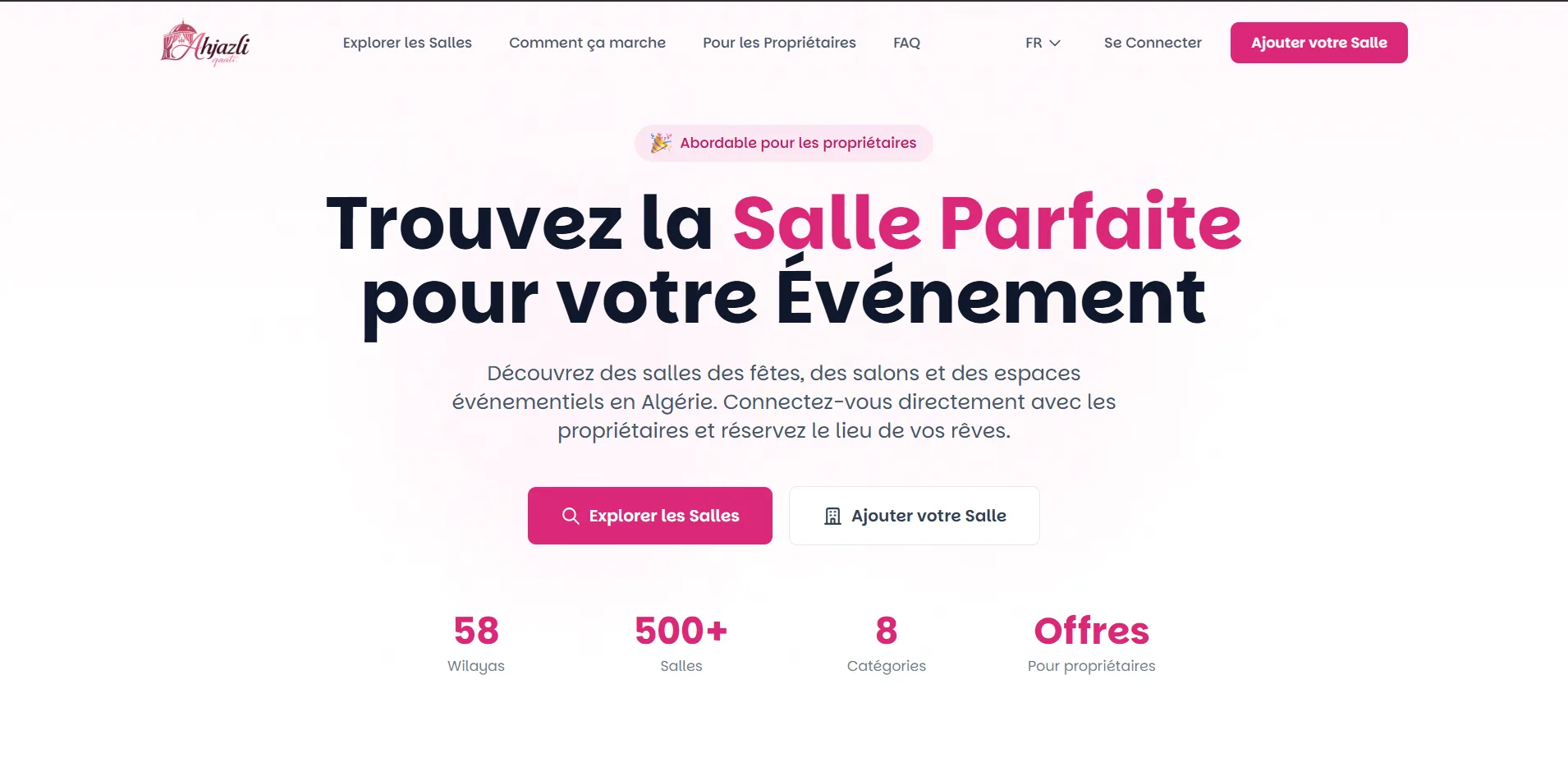
58
Wilayas covered
Discovery, listing and the generated location page set span the full national administrative map.
8
Venue categories
Wedding halls, event salons, conference rooms, garden and outdoor spaces and further venue types, each with its own filters and landing pages.
500+
Venues listed
Published directory size across the eight categories and the full wilaya map, and the inventory the generated location pages are built from.
2
Sides, one product
Hosts search and contact, owners list, manage media and read demand. Both flows ship in the same application rather than as separate portals.
Honestly
The listing-fee model is the right answer to this market and it has a real cost we should name: because the platform never touches the transaction, it never learns whether a wedding actually happened at a venue it introduced. Owners see demand, not outcomes, and we cannot rank venues by booking success because we do not observe it. Every honest alternative - a deposit rail, a verified availability calendar - requires more trust than a young marketplace has yet earned, which is exactly why they come later rather than first.
The other ongoing commitment is that programmatic location pages are an asset that has to be maintained, not shipped. As inventory shifts, combinations cross the threshold into deserving their own page, canonical targets change, and the internal link graph has to be regenerated from the data. Any version of this architecture where a human maintains that map by hand decays within a year - which is why the page set, the canonicals and the sitemap are all derived rather than authored.
Frequently asked
How do you build a two-sided marketplace in Algeria?
You solve the supply side first and make the listing valuable independent of marketplace traffic. For Ahjazli Qaati that meant every venue gets an indexable page that answers searches hosts are already making, an owner console that gets a listing live without a salesperson, and a listing-fee model instead of a commission the platform cannot verify.
What is programmatic SEO for local landing pages, and will Google penalise it?
Programmatic SEO generates location and category pages from your data rather than writing each by hand. It is penalised when it produces thin, near-identical pages for combinations you have no content for. We generate a page only when there is enough real inventory behind it, canonicalise thin combinations to their parent, and derive the sitemap and internal links from live data.
Can a marketplace work without taking payment on the platform?
In categories where deals close with a site visit and a cash deposit, yes, and often better. Hosts book directly with the owner, so we designed the contact handoff to WhatsApp and phone as the intended conversion, instrumented the demand it generates for the owner's dashboard, and monetised the listing rather than a transaction the platform cannot observe.
How do you build an Arabic-first website with right-to-left layout?
By making right-to-left the default direction rather than a theme applied afterwards. Layout, forms, navigation, number and date formatting are all built in Arabic first, and search is normalised across Arabic, French and Latin spellings of place names because Algerian users mix all three in the same query.